
The Project
Task Express is a multi-tenant AI-powered help desk and task management SaaS platform built by KRS. The platform enables users to submit support tickets that are automatically assigned, analysed by AI, and linked to a wiki knowledge base. This gives agents the contextual guidance they need to resolve issues quickly and consistently.
As ticket volumes grew, it became clear that the original Task Express system had limitations. Ticket routing and triage were performed manually. Agents were responsible for categorising, prioritising, and assigning every ticket without automation, resulting in inconsistencies, unnecessary delays, and an outdated user experience.
KRS set out to rebuild Task Express from the ground up with a complete UI redesign paired with deep AI integration capabilities, with intelligence forming a core part of the ticket workflow. The goal was a platform that was smarter, faster, and genuinely useful for the agents and end-users who rely on it every day.
The Challenge
The manual processes that had served the platform in its earlier days were holding it back, with no AI automation to support the growing workload:
- Agents navigated a dated, manual interface that slowed response times and created friction in daily workflows.
- Repetitive categorisation and routing tasks consumed time that should have been spent resolving issues.
- As ticket volume grew, manual triage could not keep pace, creating delays that affected the quality of support.
KRS needed to address these challenges by rethinking how the platform worked at its core.
The AI Strategy
KRS began a full UI redesign of Task Express, establishing a modern, stable foundation before introducing AI. This meant a solid, user-tested core product before the team layered in AI-driven features.
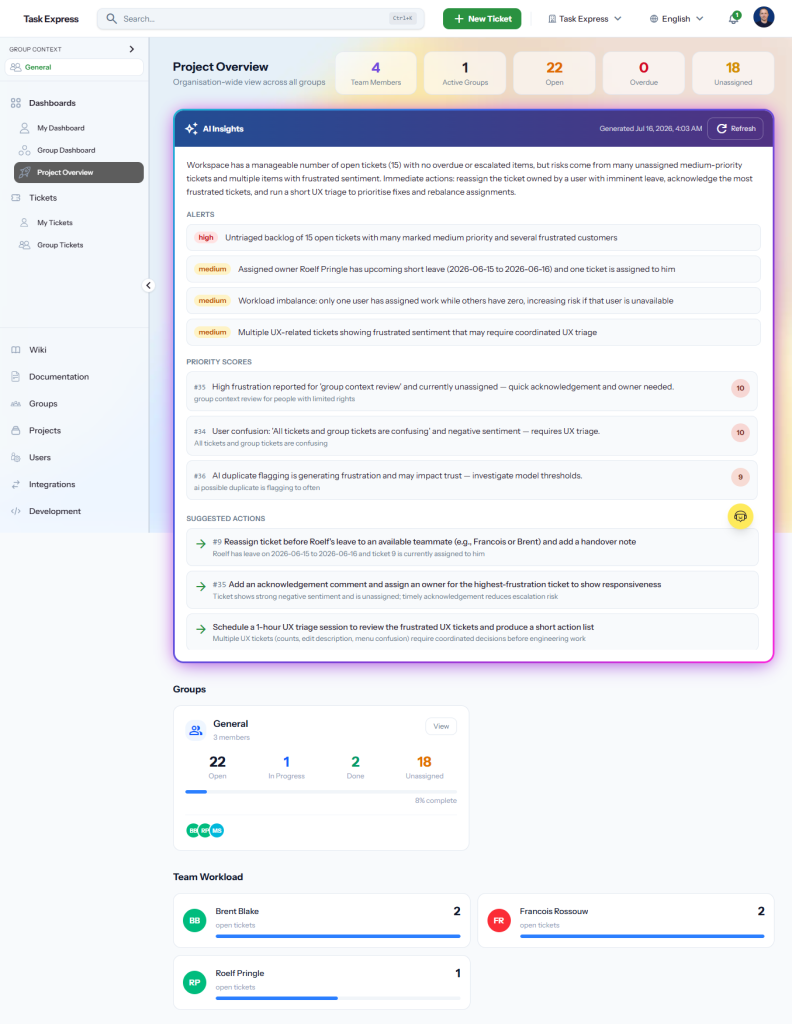
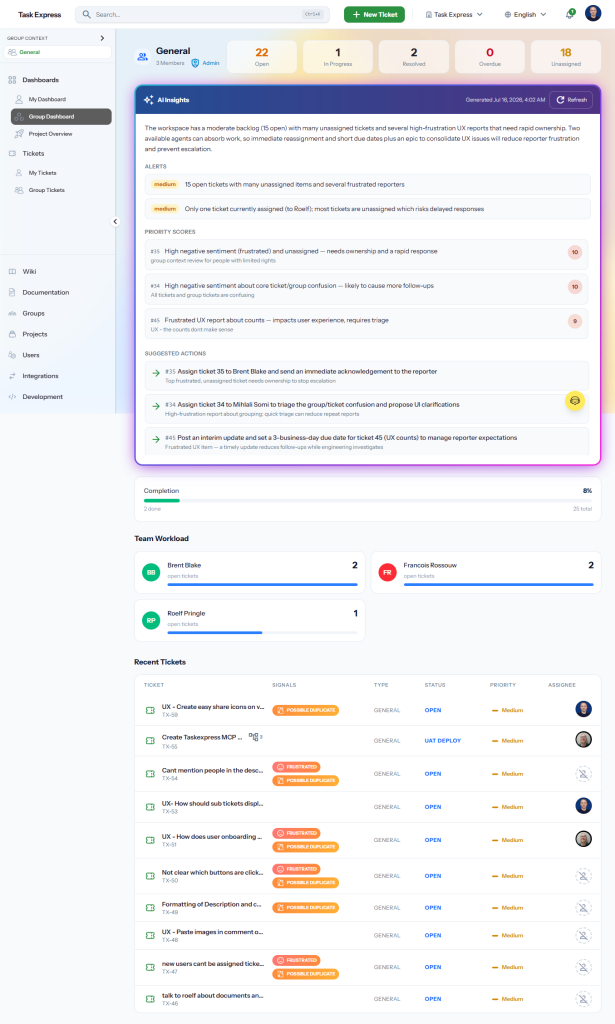
AI capabilities were then built into the core ticket workflow, including AI ticket routing, agent guidance, and background processing. The result is a platform where intelligence is embedded into meaningful touchpoints, not ticket submission through to resolution.
AI Features Implemented
- Smart, auto-assignment – Tickets are automatically routed to the most appropriate agent or team, removing manual triage.
- Wiki-grounded knowledge base linking – AI surfaces relevant articles from the knowledge base to guide agents in real time.
- AI-generated guidance – Contextual recommendations are surfaced directly within the ticket view, helping agents respond faster and more consistently.
- Duplicate ticket detection – Similar tickets are identified automatically to prevent redundant work.
- Auto language translation – Real-time content translation supports multilingual communication across tenants.
- Sentiment analysis – Ticket tone is analysed to assist with prioritisation and escalation decisions.
- AI insights – High-level analysis and summaries across ticket data provide operational visibility.
- RAG chat – Retrieval-augmented generation chat grounded in the wiki knowledge base, giving agents an AI-powered research assistant within the platform.
The Technology
Task Express was rebuilt on a modern technology stack designed to support enterprise-grade AI processing, multi-tenant data isolation, and a responsive user experience across devices.
| Layer | Technologies |
| Backend | ASP.NET Core (.NET 10), SQL Server, Linq2DB, Hangfire, Semantic Kernel |
| Frontend | SvelteKit (Svelte 5 runes), Tailwind CSS v4 |
| Authentication | Microsoft OAuth – cookie sessions with tenant claims |
| AI/ML | Azure OpenAI (Claude via Anthropic), Azure Translator, Semantic Kernel |
| AI Features | Sentiment analysis, wiki-grounded RAG, similar ticket detection, AI insights, auto language translation |
| Multi-tenancy | Shared databases scheme – every query filtered by Tenantld |
| Email Ingestion | Mailgun inbound webhook – tickets and comments |
AI Orchestration and Integration
AI integration is applied at multiple levels within Task Express. API calls are made at key workflow events, including ticket creation, update, and escalation, while background jobs via Hangfire process and enrich tickets asynchronously so AI never blocks the user experience. Semantic Kernel orchestrates all AI interactions across the backend, managing model calls, memory, and function execution.
The team built custom prompt engineering frameworks to ensure consistent, reliable LLM outputs across all features. This wasn’t just about plugging in an API. KRS developed its own tooling to control quality and maintain reliability at scale. Retrieval-augmented generation (RAG) grounds every AI response against the tenant’s wiki knowledge base, keeping outputs factual and contextually relevant.
Addressing AI-Specific Challenges
- Accuracy and hallucination management – RAG grounding against the wiki knowledge base ensures AI output remains factual and tenant-appropriate.
- Latency and response time – Asynchronous background processing via Hangfire prevents AI calls from blocking the live user experience.
- Data privacy and security – Multi-tenant data isolation takes place at every query level, with no cross-tenant data exposure through AI features.
Development Process
The KRS team took a deliberate, phased approach to delivery. The UI redesign came first, giving the team a stable, tested foundation to build on. AI features were then introduced progressively, with each one validated before expanding scope. This meant the team avoided the common pitfall of layering intelligence into a product that isn’t ready for it.
Fallback behaviour was built into every AI feature, so the core ticketing workflow always functions correctly, even when AI is uncertain or unavailable.
The development team consisted of a compact, experienced team that moved quickly without compromising quality, and included a team lead, two software engineers, and a UI/UX designer.
Results and Impact
What was once a manually operated, ageing ticketing system is now a modern, AI-powered help desk platform. The impact is felt across every part of the workflow:
- Agents are no longer responsible for manual ticket triage, routing, and classification. This allowed them to focus on resolution rather than administration.
- The redesigned interface, combined with embedded AI features, delivers a significantly more intuitive and efficient working environment.
- AI pulls relevant knowledge from the wiki exactly when agents need it, helping them respond faster and more consistently.
- Capabilities that were not previously possible, like instant language translation, duplicate detection, sentiment-informed prioritisation, and RAG-powered chat, are now part of the standard agent experience.
For KRS, the rebuilt platform serves a dual purpose. It’s a production SaaS product that delivers real value to its users, and a live proof point of what KRS can deliver when bringing AI into business-critical systems.
Lessons Learned
Building AI into a live production platform taught the KRS team lessons that now shape every engagement:
Start simple and iterate: AI features were introduced incrementally, each one validated before expanding the scope. This approach reduces risk and builds confidence in what the AI is actually delivering.
Grounding is non-negotiable: RAG and knowledge base anchoring are essential to keep LLM outputs trustworthy in a production environment. Without grounding, AI features break down trust rather than building it.
Architecture matters early: Multi-tenancy and data isolation must be designed in from the start. Retrofitting tenant-safe AI into a system that was not built for it is costly and risky.
UX and AI must co-evolve: Rebuilding the UI first created the right foundation for surfacing AI in meaningful, user-friendly ways. Intelligence that users cannot find or understand delivers no value.
What Makes KRS Different
KRS takes a deep integration approach. With Task Express, AI wasn’t added as a surface-level feature but built into the core ticket workflow at every meaningful touchpoint. From submission through routing, guidance, detection, translation, and insights, AI operates as a first-class citizen of the system.
Ready to bring AI into your product?
KRS practices what it delivers. The same thinking, methodology, and tooling that shaped Task Express is brought to every client engagement. If you’d like to know how KRS, a Cape Town software company, can help you build or improve your technology product with AI capabilities, get in touch with us to discuss your product vision.